


Dear every body,
I’m incredibly excited about today’s newsletter, which is an exclusive behind-the-scenes with filmmaker Kyla Harris on her BBC TV series We Might Regret This. Please join me in welcoming Kyla to Body Babble!
I first met Kyla in 2019, when I joined the British Film Institute (BFI)’s Disability Screen Advisory Group. We were a group of disabled filmmakers advising the film and TV industry on disability representation. I had just joined; Kyla was one of its founding members.
Funny and warm, Kyla instantly made me feel welcome, and over the next few years we bonded over art, disability in storytelling and shared humour. We’d hang out when we bumped into each other at screenings or on panels, when we collaborated on projects or when I visited her in her beautiful Brighton home. Slowly we came to mutually refer to each other, in affectionate recognition of our bodies’ needs and limitations, as ‘Fleshy Sack.’
I’ve long admired Kyla’s work, so it’s been fun in the last few years to see the rest of the world fangirl over her too. The first season of her BBC TV show We Might Regret This was released in 2024 to critical acclaim, and the second season, which came out earlier this year, is perhaps even better.
The show is laugh-out-loud hilarious. It’s taboo-breaking in its representation of disability, bodies, sex and interdependence. And it’s political in a way that never feels preachy. Even its smallest details mean so much to me: like hearing the click of the main character’s power-chair which, to me, is the sound of some of my most beloved friends entering the room.
I’m thrilled to share this conversation with Kyla with you today.

In this edition of Body Babble, we’ll cover:
Writing when ‘you feel like you’re dying’
Creating an accessible set
Wheelchair strippers!!!!
Kyla’s next project
Writers often talk about their writing process as if they’re floating disembodied brains, not bodies that have needs or limitations. What was your process of writing the show?
Kyla: I think everything is shaped and informed by how I’m feeling. It guides what I am able to do, how much I listen to or ignore myself, and how much writing I get done.
I think most writers will say that writing is an awful process. It’s horrendous and difficult. But it’s even more horrendous and difficult when you feel like you’re dying, which I do most of the time! And I laugh at that, but I’m also semi-serious.
Because I was new to writing and had learned everything, really, from Lee Getty, the co-creator/ co-writer, I pushed myself so much again and again and again, to try to prove that I could do it.
How did you make the set accessible to cast and crew?
Kyla: The BBC was really encouraging of access and support.
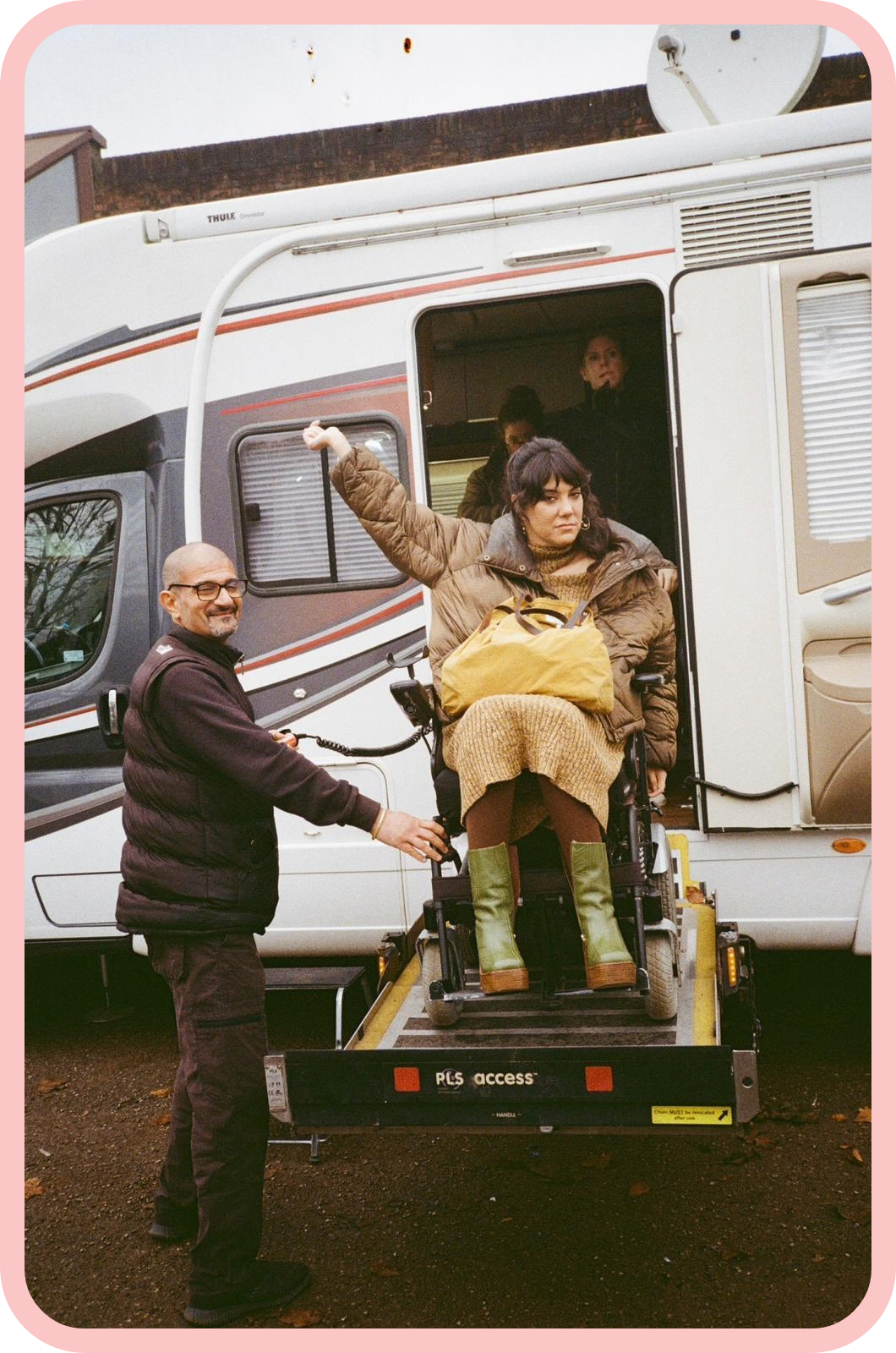
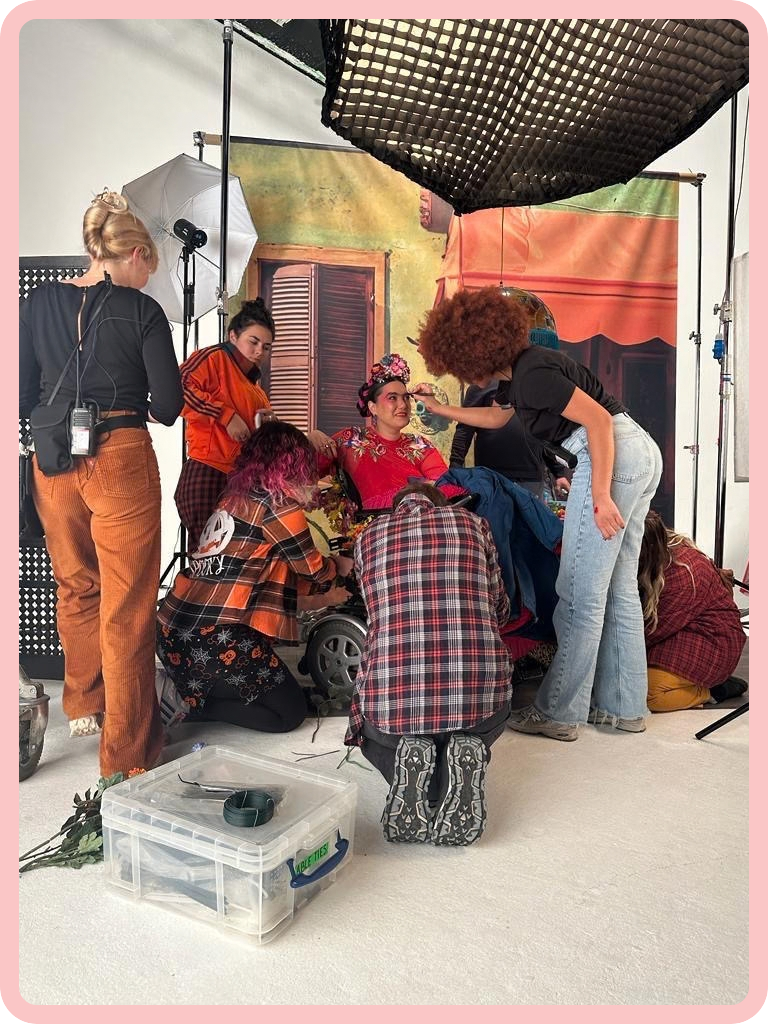
They made sure I had an accessible vehicle to use as a trailer, because there’s actually only one wheelchair-accessible TV trailer in the UK, and it was busy. So I used an accessible camper van as my trailer for hair and makeup when we were on location.
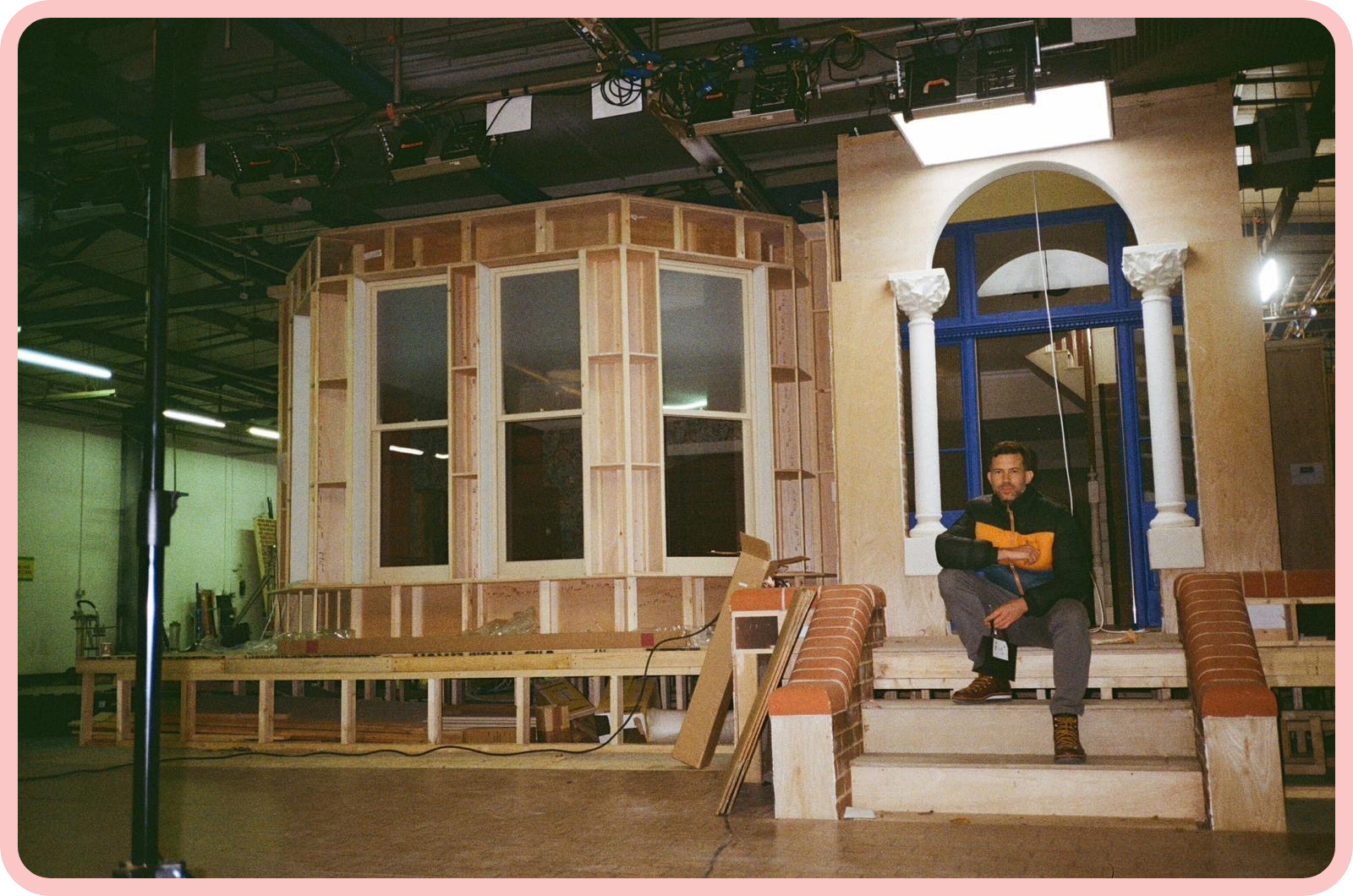
For story purposes, Freya and Abe’s house needed to be inaccessible, but of course I needed to be able to access it. So we had a studio for that: we essentially made this inaccessible house and then behind the set, we had a ramp up to the back of the house.
Working with Ella Glendining as an access coordinator was amazing. And then on the second season we worked with Jess Mabel Jones and Dan Edge, who were also fantastic.
My ideal would’ve been that they were on set every single day and that we could’ve really created that community, that sense of care. But access coordinators are a relatively new role, and funds are being cut left and centre in the film and TV industry.
How did you manage your energy on set?
Kyla: There wasn’t any opportunity to rest on set, or very infrequently.
We set up my schedule so that I would be on set for 11am. At 8am I’d wake up and within fifteen or twenty minutes, my hair and makeup artist Tara, who is amazing, would come into my room. I’d be doing stretches in bed while she was doing my makeup. And then I’d get up and I’d be having breakfast while she was doing my hair. So when at 11am I came onto set, it was like, ‘Everyone’s ready, we’re good to go.’ And they’d be shooting scenes before then that I wasn’t in.
Another energy saver was Lee, because we were both exec producers. Lee was there on set every single day to deal with questions that I would’ve also dealt with, so she took a lot of that weight. She was rewriting scenes every single day on set.
Does it become easier to have your access needs met when you’re higher up in the hierarchy of production? In other words, because We Might Regret This was your show, did that make it any more accessible for you?
Kyla: I suspect I was afforded a lot of privilege in getting those needs met because I wouldn’t have been able to participate otherwise. If someone was, say, a trainee or a more junior role, and they said, ‘I want to be on set, but I need an accessible set’, I suspect they wouldn’t have been as supported, which is a huge shame.
Did you face any logistical or accessibility challenges during the shoot?
Kyla: Nick Collett was the director for the first season, and he hired Will Hanke as director of photography. Nick and Will are absolute artists.
We did a lot of lens testing beforehand with a lot of shots from my perspective, which is unusual because when I’m moving through rooms, I’m sitting down.
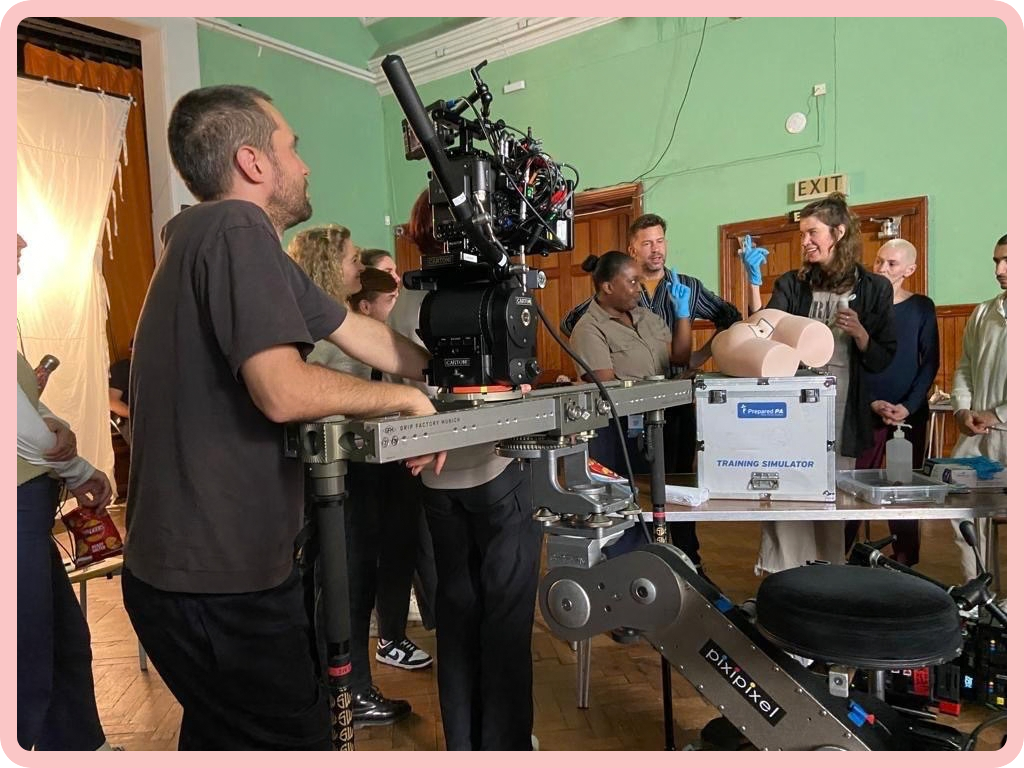
Will was using a handheld camera to begin with, and walking and following me, but he realised that it wasn’t quite gelling. He realised that the reason it worked with other people but didn’t work with me, is that when you’re both walking, even though your steps are not at the same time or synchronised, there’s a mirroring in that movement.
But because I was moving more fluidly [because I’m a wheelchair-user], we created what we called a ‘butt dolly’, which was essentially a glorified stool with wheels. Will sat on the stool with wheels and would follow me on the camera.
Those epiphanies and creative decisions were so exciting and rewarding.
Exciting because there was no roadmap for how to shoot these kinds of scenes? So in a way, you were creating your own language of ‘wheelchair filmmaking’?
Kyla: Yeah, absolutely. When Will the DOP, Nick and Lee and I were looking at the cinematography, we looked at the canon of films out there that portray disability.
So for instance, I can’t stand those shots when it’s sad music tracking up someone’s legs in a wheelchair, making the character a source of pity. It’s become a classic, which is so unfortunate.
Or a lot of the time the camera is focusing on the person that’s wheeling the person in the wheelchair, not on the wheelchair-user. But we wanted to completely break that convention.
We took the idea of breaking these tropes as a really exciting creative brief to work with. The visual language for representing disability from a disabled perspective is so untapped, and that’s so thrilling.
People sometimes talk about a female gaze or a queer gaze onscreen. Would you agree that We Might Regret This has a disabled gaze?
For example, the scene on the plane where Freya’s being transferred and she gets manhandled and everyone’s sighing. Or Crip Tease Dan, the disabled stripper. Or the moment where Freya accidentally slips out an ableist slur, and one of the Olivias says ‘The online disabled community, they’re dragging you.’
That was so funny to me because, even working in this space and being disabled myself, there’s still a fear of ‘What if I say the wrong thing? What if I get cancelled?’
Kyla: I think there is a disabled gaze in so many ways. I love the moments you picked out. Those moments are really a commentary on how a lot of the time, our community does have different perspectives. Everyone who’s not disabled is so obsessed with language and the idea of ‘getting it right.’
But we loved the idea that anyone in the disabled community can also get it wrong. Just because you’re disabled, it doesn’t mean that you don’t have internalised ableism. A lot of really harmful stuff that I’ve experienced has come from other disabled people. So I think there’s a commentary on disabled people not being a monolith.
Oh, and Crip Tease Dan. I remember having my accident and being in the ICU and being like, ‘How would I strip? How would I become a stripper?‘. This is the brain of a 15-year-old: ‘Well, my career as a stripper is clearly ruined.’
What did you love most about making the show?
Kyla: There were so many moments in pre-production for this series where I was like, 'Oh my God, this is the best job ever.’ One of them was watching the audition tapes for Crip Tease Dan, and seeing how multiple people would’ve undertaken the job.
Seeing Kris who ended up playing him, I was like, ‘Oh my god. I have never seen that move before.’ The one hand on the floor and gyrating into the air. I was like, ‘Why has the world not seen this? This is sexy as fuck, and talented as fuck.’
What did Kris have that the other wheelchair strippers didn’t have?
Kyla: Mainly that move. But also, there was a kind sexiness to him. He was just so lovely, and there was a lot of care that he brought to the role. And to me, that speaks volumes about how disabled people approach intimacy and sex, with this care for the other and an increased awareness of their own body.
The show is groundbreaking in its representation of disability. Did you feel the weight of responsibility?
Kyla: I always think back to this moment when we were at a school assembly and there was a wheelchair-user that came to speak to us. I was newly disabled, maybe a year into my injury, and they essentially had someone come to talk to the entire school about me, not asking me but having someone else give this inspirational speech. And I remember her talking about needing to be catheterized and the entire school laughing. And I felt so much shame and humiliation in that moment, and I didn’t want to bring that to anyone else by making this series.
I was aware that there would be a lot of people who would be disabled themselves, who would be uncomfortable with some of the things that I said and did [in the series].
I was afraid that people would conflate my understanding of ableism with Freya’s. But Freya is at an incredibly different stage of understanding ableism than I am. I am light years ahead of her. So it was about showing the journey of internalised ableism.
I was afraid that people might feel too exposed if they’re not ready to talk about these things. But I also feel like part of undoing that shame around our bodies and minds is by talking about it, and showing it in a respectful and educated way. And I think that’s what we did.
Are you working on anything new?
Kyla: Ella Glendining and I are working on a feature film that’s set after the Witchcraft Act is published in Scotland in 1563.
Tell us more?!
Kyla: Two disabled midwives known as Living Saints are accused of witchcraft. After assisting in the delivery of a disabled baby and heir to a wealthy and powerful landowner, he turns on them by accusing them of witchcraft.
Historically, the huge majority of people accused of witchcraft were disabled people, and that’s not really talked about. And witch hunts are still very much alive today for disabled people. Applying and being interviewed for benefits often feels like an interrogation. And people who are pregnant with disabled children are encouraged to abort them.
So I think it’s of historical interest, but hugely contemporary as well. We’re looking for funding. It’s so close to my heart and encompasses so many of my interests.
Watch We Might Regret This on BBC iplayer.
Follow Kyla Harris on Instagram.
Thank you…
A huge thank you to Kyla for chatting with me about We Might Regret This, which I loved so much, and for your friendship over the last seven years.
Thank you to Naomi Chapman for help with editing.
Thank you so much for reading. If you enjoyed this post, please share it with your friends! Writing and independently publishing these essays and interviews on no budget is a labour of love and your support really helps me keep going!