


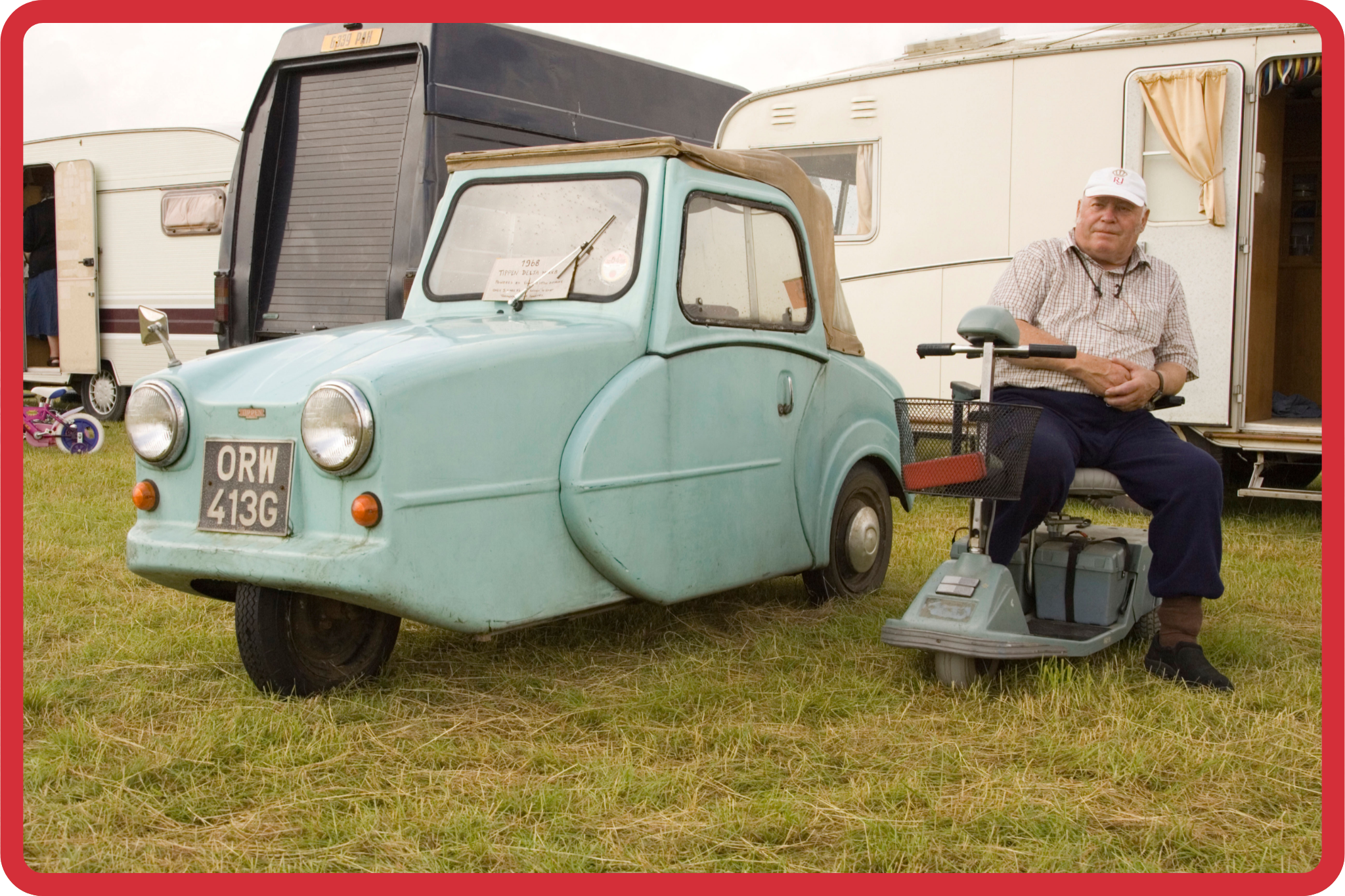
Dear every body,
Did you know that the UK government used to lease disabled people a tiny blue three-wheeler? And that by the mid-1970s, these cars were driven by 25,000 people?
It’s UK Disability History Month (20 November- 20 December), and today we’re talking about the invalid carriage, also known as the Invacar. If you’re from a similar generation to me (b. 1995), you might not be familiar with this little blue “disability car.” I first came across it a few years ago, while browsing the British Film Institute’s online archive. I was fascinated to see footage of a noisy, blue three-wheeler that looked like it would topple at the slightest wind.
How had I never heard of it? How did it feel to drive one? And how much more disability history had I missed? Immediately, I was obsessed. I even wanted to make a film about it. But information online was scarce and repetitive, mostly spread across motoring forums, Reddit, and the odd thread of Boomer Facebook comments. The youngest ex-drivers of invalid carriages are now in their seventies, and finding first or even second-hand sources is becoming a challenge. Several times I’ve discovered a new lead, only to find out that the person had actually died months or years before.
Time is running out. We have years, not decades, to capture this piece of history using first-hand sources. And it’s not just about its cute aesthetic (although I agree, it’s adorable). I think that understanding the invalid carriage might help us navigate the ongoing fractious relationship between disabled people and the state.
Never has this been more relevant than in the UK in recent months. An ongoing scapegoating of disabled people has become backlash against Motability, a scheme which leases adapted vehicles to disabled people, and which was introduced in 1976 as a replacement for the invalid carriage.
I want to speak to a generation who knew the Invacar, to understand why it was eventually made obsolete by Motability. Was the invalid carriage loved? Or hated? Was it freedom on three wheels? Or a fibreglass death-trap?
Let’s find out…

In this edition of Body Babble, we’ll cover:
What’s an invalid carriage?
The mission of the Invalid Carriage Register
Simon and Kay’s memories of their grandfather and his invalid carriage
Problems with the vehicle
How the invalid carriage was finally scrapped and replaced by Motability
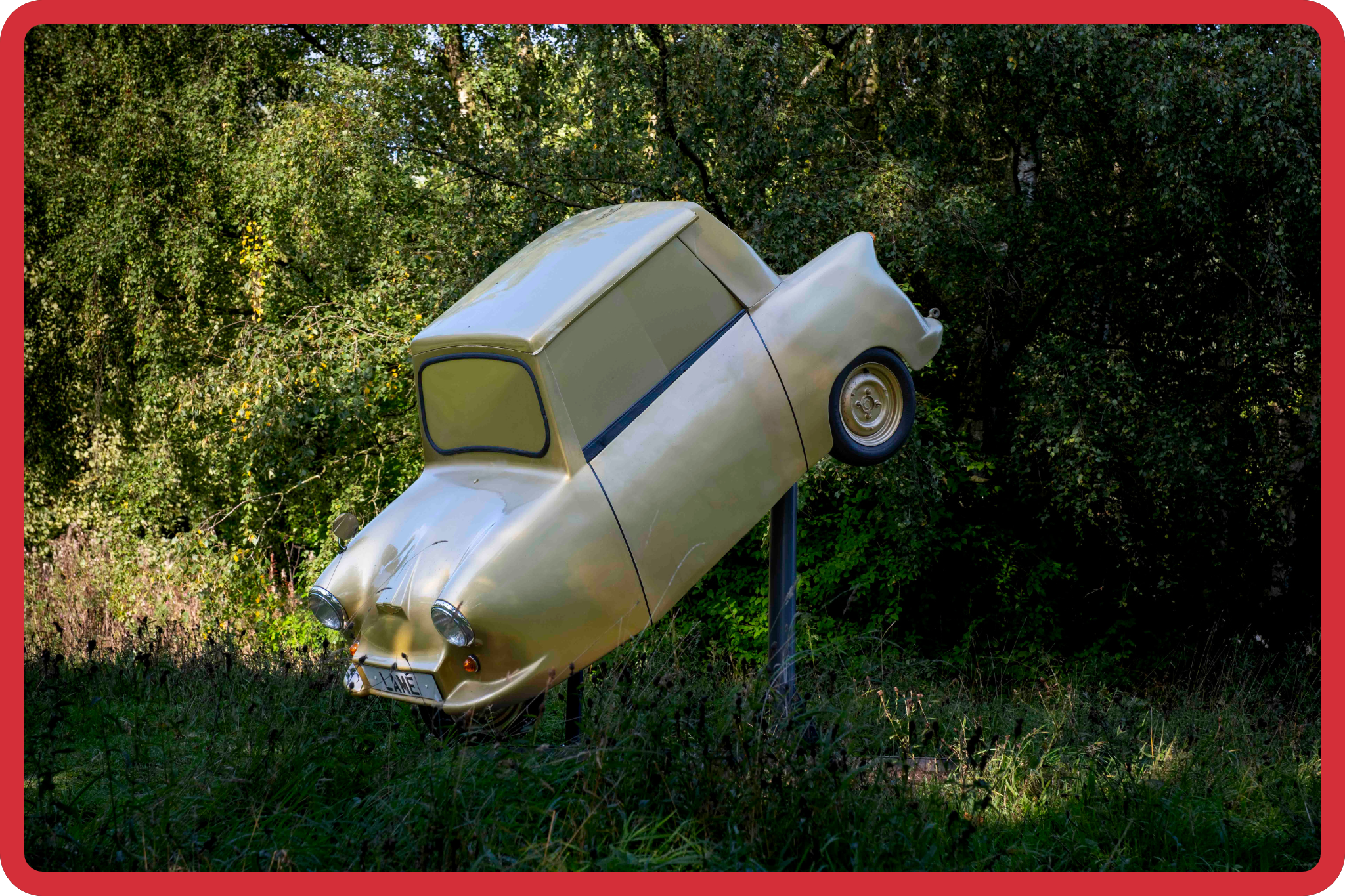
Why artist Tony Heaton spray-painted an invalid carriage gold
The role of the invalid carriage in disability history and in understanding today’s backlash against Motability
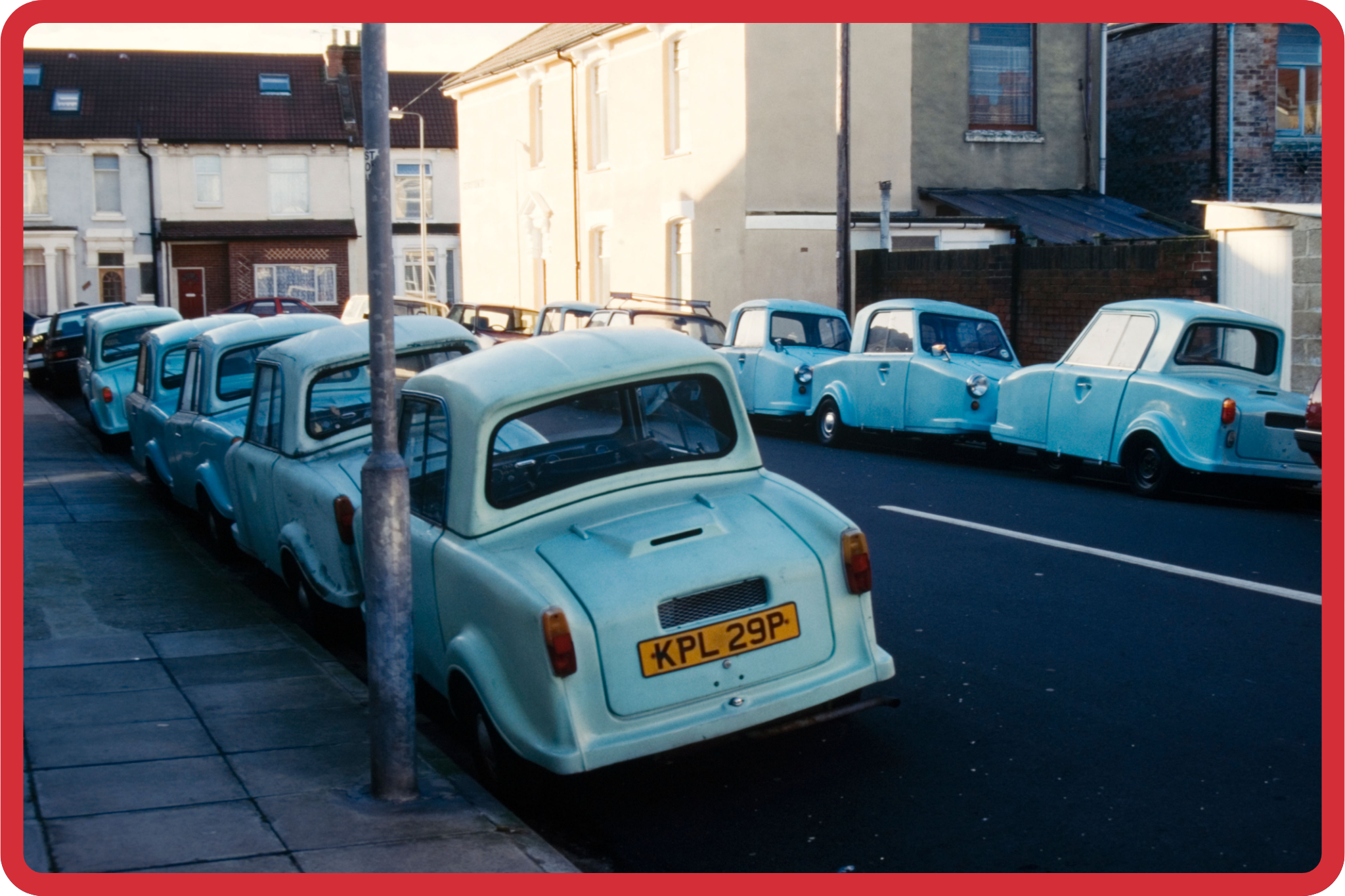
What actually is an invalid carriage?
It sounds archaic, but “invalid carriage” is currently the legal term for power wheelchairs and mobility scooters in the UK. However, for much of the 20th century, “invalid carriage” referred specifically to any small, three-wheeled one-seater vehicle which was leased by the UK government to disabled people.
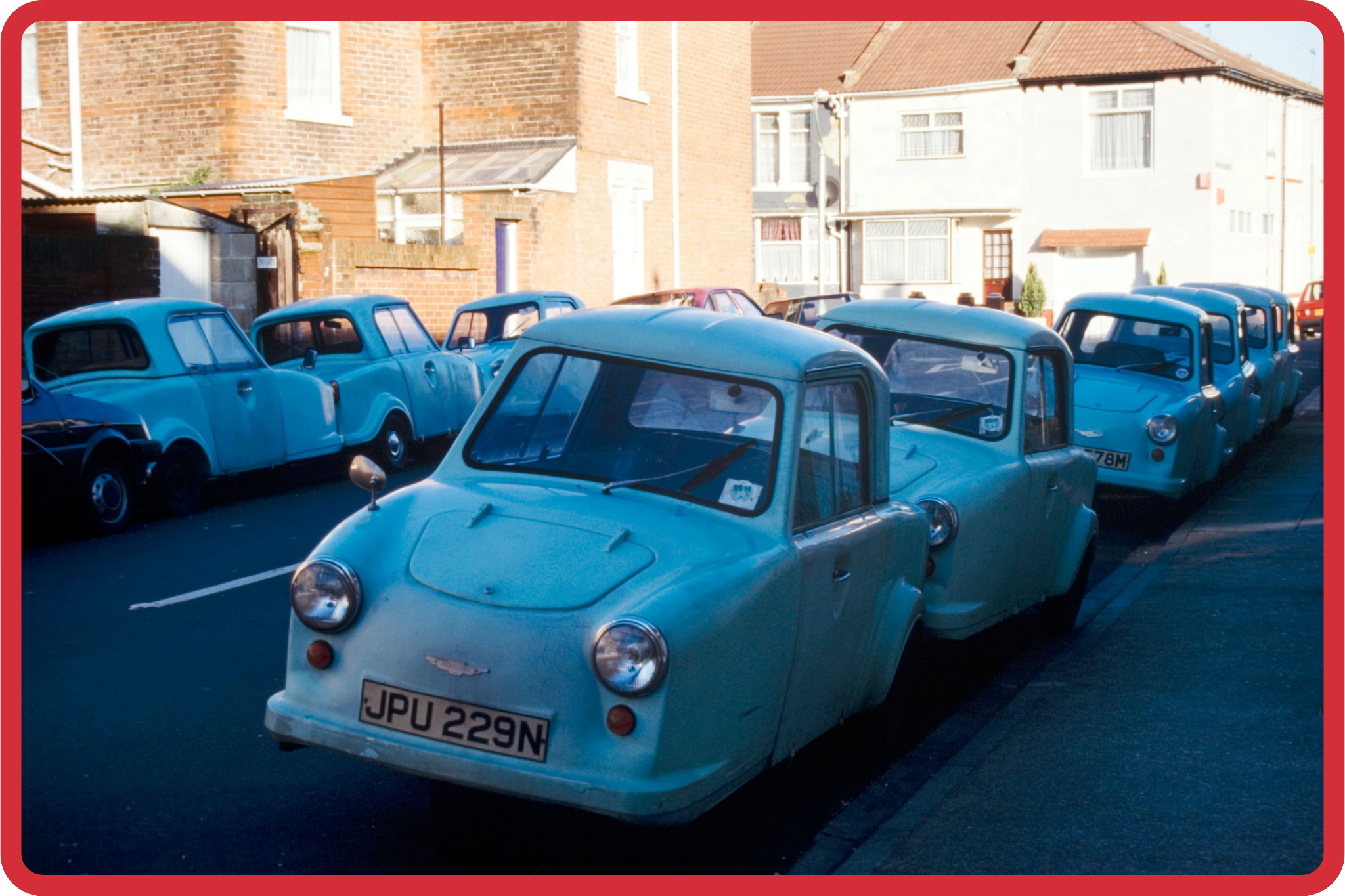
Different kinds of vehicles can be described as invalid carriages, including the 19th century wicker Bath Chair. But most often, invalid carriage is synonymous with the iconic Invacar: a pale blue motorised tricycle with a fibreglass shell which, from the ‘50s to the ‘70s, was leased by the UK government to qualifying disabled people. The “classic” blue invalid carriage is often the AC Model 70 Invacar, but variants were made by other manufacturers, like the Thundersley or Tippen Delta. In this article, I will be referring to these interchangeably as “Invacars” or “invalid carriages.”
Putting the vehicle back into public memory
Simon McKeown is the director of the Invalid Carriage Register, a volunteer-run project which promotes and conserves the history of the invalid carriage:
“Our mission is to put the invalid carriage back into public memory, because it’s currently missing,” he says. “Especially from young people’s memory.”
The project does its best to track all known invalid carriages worldwide, of which there are believed to be 300-400. Most of these are found in the UK, but “a small amount were distributed through the Commonwealth, so some of these vehicles are in different countries as a result.”
As medical tech and mobility aids rapidly develop, Simon thinks there is more need than ever for designers to be aware of the history of the invalid carriage. For example, a few years ago, Toyota ran a competition which awarded $1 million to the most “game-changing technologies” which could “improve the lives of people with lower limb paralysis.” The finalists included exoskeletons and a self-balancing, intelligent wheelchair.
But Simon is concerned that those young designers won’t have been able to access a design history which included the invalid carriage:
“Without history, we often think that it’s never been done before. But without knowing that these vehicles existed, how do you design better vehicles?”
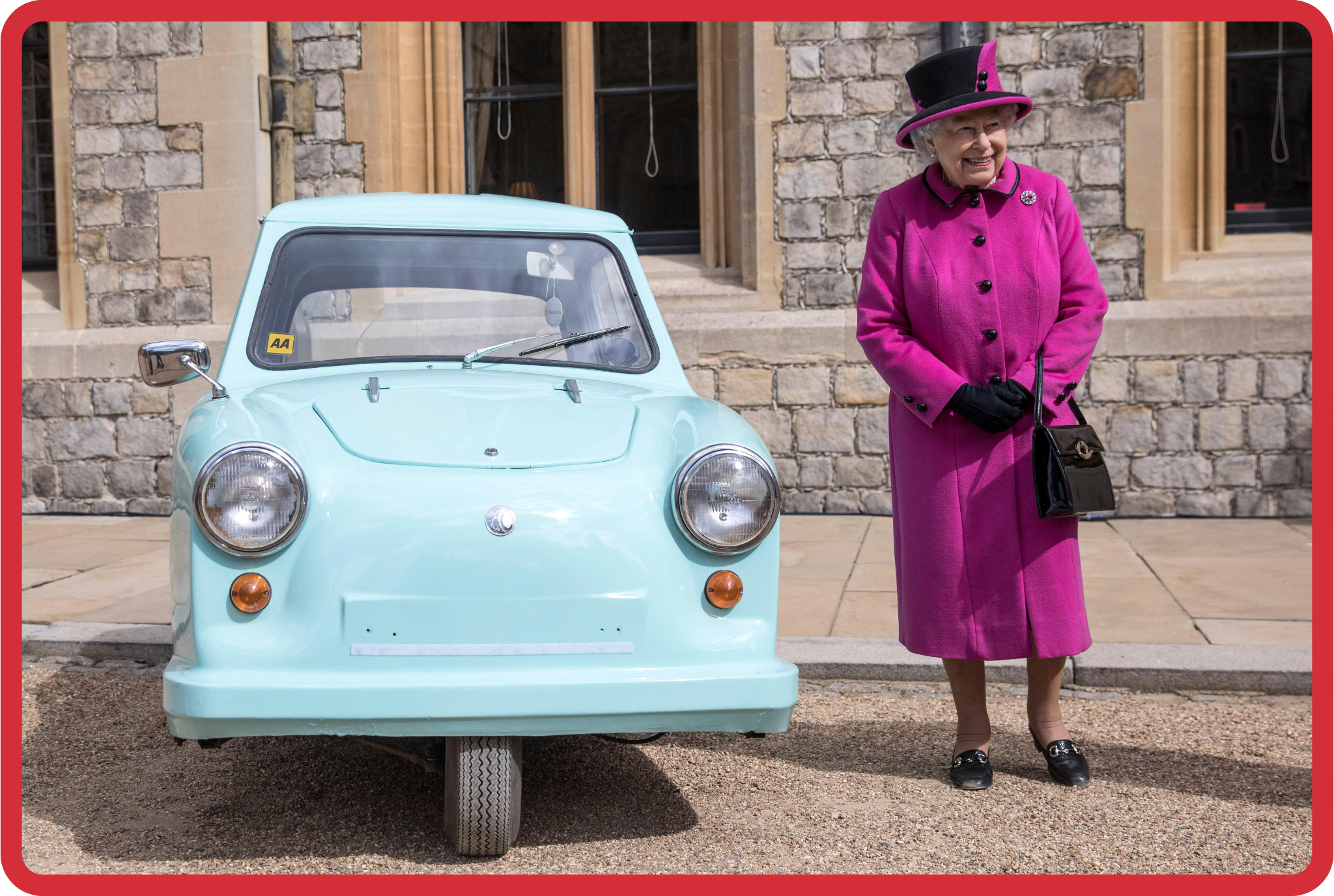
A family history
For Simon, the invalid carriage represents first of all a “family history.” Simon’s grandfather, Ian Jones, had osteogenesis imperfecta, also known as brittle bone disease. He couldn’t walk very far and supported himself with a crutch; mostly, he used a wheelchair. He was from North Yorkshire, working class and “extremely poor” because although he was “very, very clever […] nobody would hire him.”
This was the late 1950’s and early ‘60s, decades before the UK would pass its 1995 Disability Discrimination Act, which would make public transport accessible to disabled people (at least, in theory).
“Before mobility was a provision, people couldn’t travel very far,” says Simon. “They couldn’t necessarily work. He couldn’t just get on a bus.”
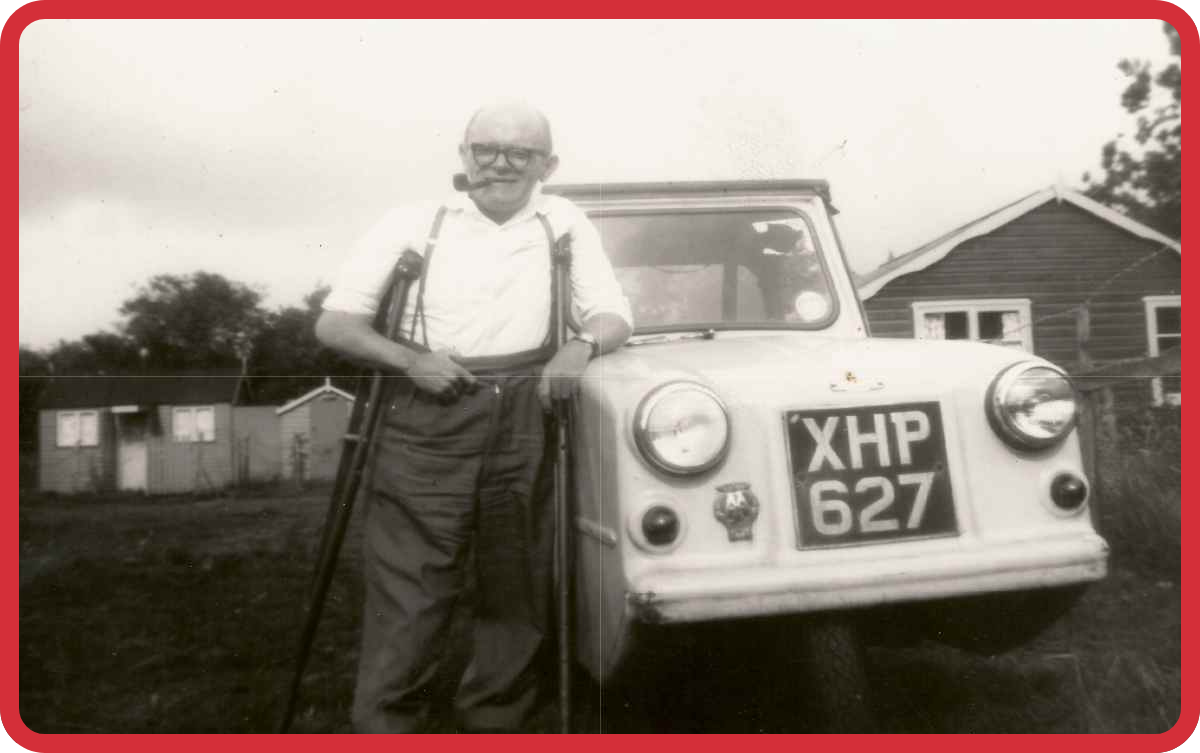
When Ian was leased a government-issued invalid carriage, “it gave him a level of freedom.” He was able, for example, to take one of his first and only holidays, to a caravan park which he drove to on his own. Simon shows me a photo of Ian on that holiday (see below). He’s supporting himself on his crutches, and proudly leaning against his Tippen Delta, with a pipe in the corner of his mouth and a smile.
“I think you can see that he’s pleased", says Simon. “He genuinely liked the car. But I don’t think he enjoyed breaking down on his own particularly.”
Freedom, at what cost?
The invalid carriage was certainly cute, colourful and innovative. And there’s no doubt that for many, it provided an unprecedented freedom. But the reality of driving the vehicles was less than ideal: they were noisy, smelly, unstable, uncomfortable, poorly-heated and constantly breaking down. Built with a lightweight fibreglass frame, they were known to tip over in strong winds or even catch fire.
In a news report from ATV Today in 1969, a reporter asks three disabled motorists about their experience driving their invalid carriages.
“I broke down seventy-two times in six weeks”, says Mrs Goodman, who at the time of interview had been driving one for nineteen years. She adds: “The smell of the exhaust that comes into the cabin is really obnoxious.”
A single-seat design
One of the most controversial parts of the design of the car was that it was designed to seat only one person—as if disabled people had no families, friends or partners of their own. On the dashboard, a sign read “Passenger Carrying is Forbidden”.
This had its consequences. In the news segment from 1969, a disabled driver says:
“I have known a case recently where it has actually split a young married couple, in that the husband became disabled. He was issued with a vehicle. But because he couldn’t take his wife and child with him, she left him and he had the responsibility of the child, which had to be put in a home.”
Insisting that I should understand the unique “physical experience” of being inside an invalid carriage, Simon puts me in touch with his sister Kay. At ten years older than him, she has more memories of their grandfather’s invalid carriage: he died in 1971, when she was fifteen. “I was brought up by my grandparents,” she tells me. “I was their daughter.”
I ask Kay how life changed for her grandfather when he was leased an Invacar. “It was good and bad,” she says. It meant “he actually had some kind of transport” and they could travel slightly further afield:
““We would go to these little country places on the bus,” she says.
But their freedom was limited by the Invacar’s single-seat design:
“We had to go separately. Me and [my grandmother]. And he would drive the blue thing. We didn’t know whether he’d make it or not. We didn’t know where he was and he didn’t know if the bus had got there.”
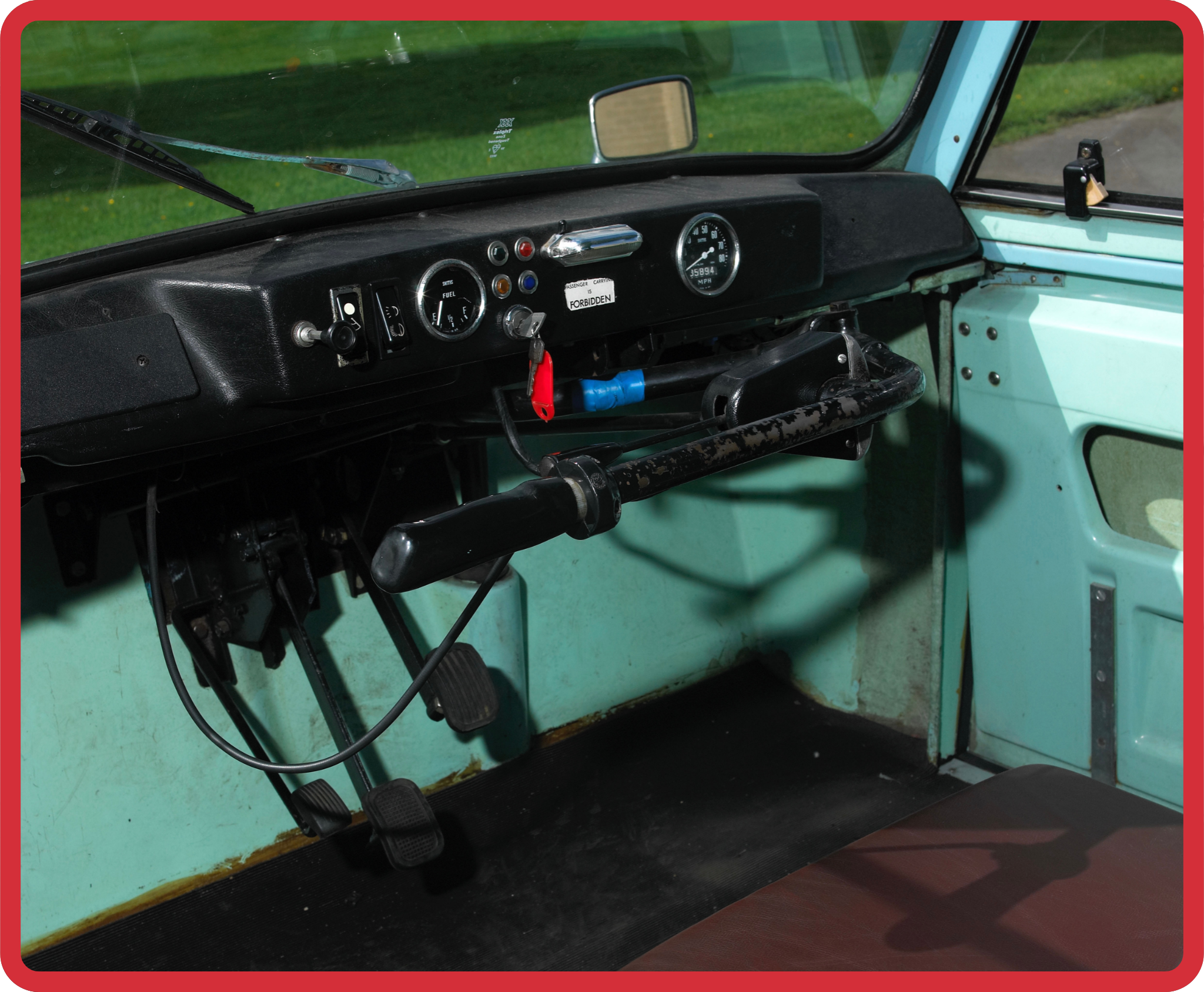
Kay remembers being six or seven and helping her grandfather go to the shops or into Middlesborough, their nearest city. In order to accompany him, she had to crawl into the front of the Invacar and fold up at her grandfather’s feet:
“Obviously there was no pedals,” she says. “So as a small child, I could fit. I would be sat on my bottom with my knees hugged up to myself. And then we would get his wheelchair dragged in and the door shut.”
“What we did was against the rules,” she admits. But how else were they supposed to get around as a family? Buses weren’t yet accessible, and this was “a time when there was no dropped kerbs.”
Kay says, with a shudder:
“If you step back and think about it… I was in something with a fibreglass body, hiding in the nose part at the front. Nobody knew I was in there. There was no evidence. If there’d been any kind of accident—it’s horrendous.”
The end of the invalid carriage and the birth of Motability
With mounting safety concerns and campaigners raising awareness of the fact that a single-seater didn’t suit the needs of most disabled people, in 1976, the invalid carriage scheme was finally scrapped. Production ended in 1981, and any remaining cars were recalled and banned from use on roads in 2003.
Looking back, it seems obvious that the cars were grossly unsuitable. At the time, however, many disabled people had come to rely on their vehicles, and had little faith that the government would quickly come up with a more suitable replacement. When the scheme’s closure was first announced, there were protests.
In a TV news report from 1977, protestors arrive, engines revving, in their invalid carriages, at a hotel in Solihull where Social Services Secretary David Ennals was about to make a speech. One of the little blue cars has been adorned with Union Jack bunting and a handwritten banner which reads “IT’S A RAW DEAL, ENNALS.”
An older woman protestor is the first to confront Ennals:
“How would you feel if you lost the use of your legs? What would be your position then? Someone ought to chop your legs off for a month and just see how you can get on with that!”
When Ennals patronisingly replies, “Well, look dear, I spent three years in hospital after the war, that is why I’m so committed to doing more to help disabled people,” the protestor raises her voice: “It doesn’t sound like it,” she says. “It sounds like we’re fighting a dead duck!”
Another protestor, an older man, also confronts Ennals:
“You’re going to take my legs,” he says, “And you’re going to give me nothing?”
Later in 1977, the government introduced the Motability scheme, which replaced the invalid carriage. Motability is a UK-wide scheme which leases disabled people cars, wheelchairs and mobility scooters (sometimes with adaptations), in exchange for giving up the mobility allowance of their disability benefits. In 2025, the scheme had 860,000 customers.
But in recent months, Motability has been all over national headlines, attracting particular hysteria from right-wing press and politicians. Ahead of cuts to the national budget, leader of the Conservative Party Kemi Badenoch announced: “We will restrict Motability vehicles to people with serious disabilities. Those cars are not for people with ADHD.”
Meanwhile, MP Lee Anderson, welfare spokesperson for the far-right party Reform, called to bring back the invalid carriage:
“I remember back in the day if you were on disability and you wanted a car from the state it was a blue three-wheeler. What’s wrong with that? Let’s go back to that.”
There is, of course, plenty wrong with Anderson’s statement, which seems not to be based on any real understanding of the history of the car. But it struck me as interesting how the invalid carriage—which is so unfamiliar to millennials and Gen-Z—remains an object of significance and fascination in an older generation’s collective memory of disability.
“From Lame to Lamé.”
“It’s the most iconic disability object,” says artist Tony Heaton OBE, one of the most eminent voices of the UK’s disability arts movement.
In 1971, at the age of sixteen, Tony became disabled after an injury and was leased an Invacar (which, like a motorbike, sixteen-year-olds were allowed to drive on a provisional driving license).
“When I had my transition into the world of disability, I transmuted from a motorcyclist to an invalid carriage driver,” he says. “It was kind of a culture shock.”
But he adds:
“I embraced it. It still had an engine. I could still fire it up and drive around and be independent. I screwed it to its limits, really. I went as fast as it could. And I was still surrounded by my friends, who were all bikers. So we would make this formation of three or four guys on motorbikes with this little blue invalid carriage in the middle of it. Like some kind of weird convoy!”
When Tony turned seventeen, he gained his full driving license and was leased a Mini, which was safer and could take passengers. But decades later, he found himself thinking fondly back to his old blue Invacar.
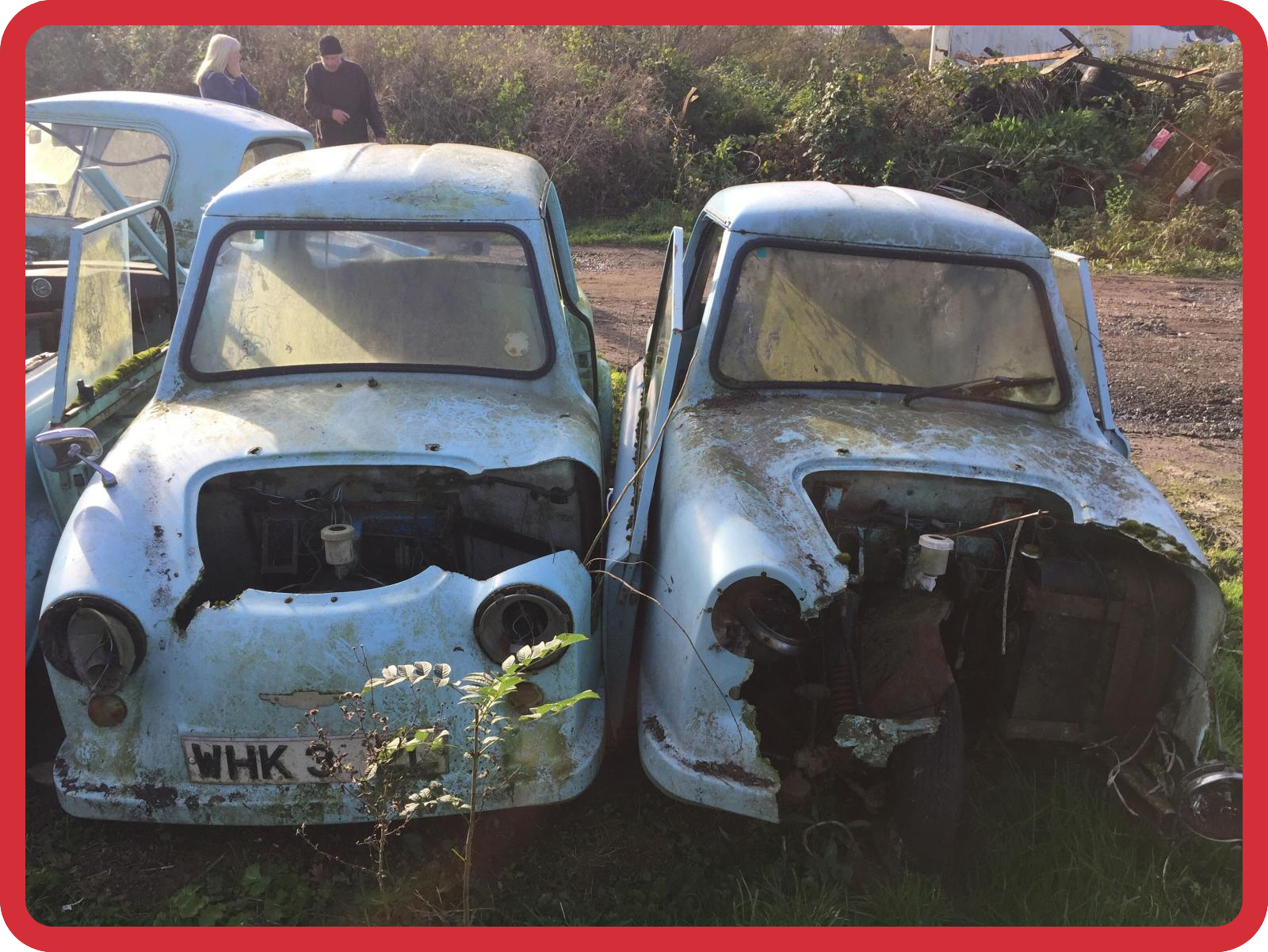
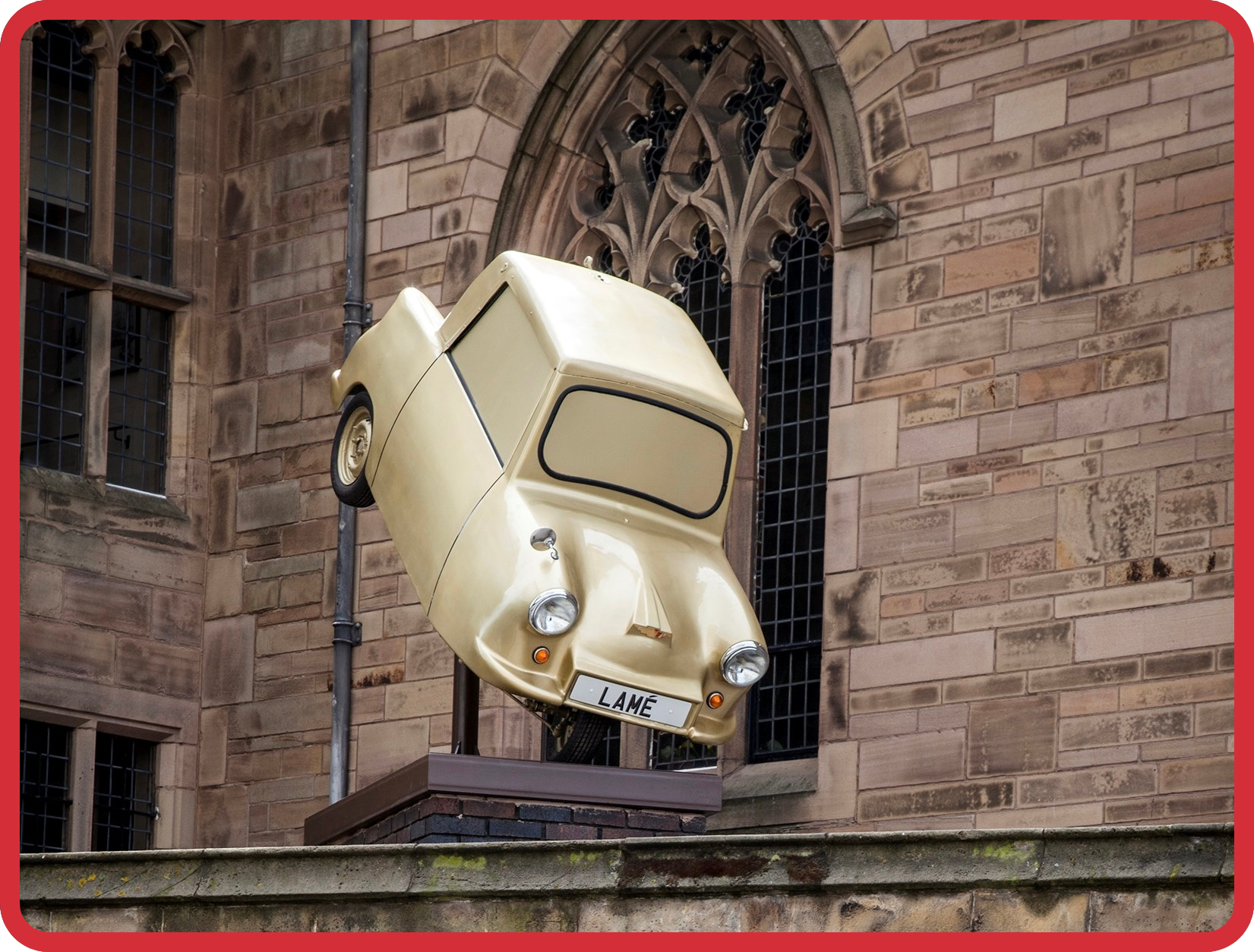
Tony began to work on an art installation, inspired by the idea of alchemy, and how alchemists “turn base metal into gold”. He managed to source an old invalid carriage online, which was “rotting away in a field” near Bristol. He replaced the rotten metal door, stripped down the fibreglass frame, and took out the engine, the seat and the gearbox to make the car as light as possible, leaving only the steering wheel, so it could still be steered if necessary. Then he spray-painted it gold.
Finally, he mounted it on a plinth at an angle, and added a custom numberplate which reads LAMÉ. The piece, titled Gold Lamé (gold lamé is a metallic fabric), has exhibited across the world, including at the Venice Biennale. It’s currently at Yorkshire Sculpture Park.
“It’s crashing to earth from up in the heavenly stars, where they’ve all been withdrawn from service,'“ says Tony. “They’re all up in car heaven, but this one has escaped and come crashing back down to ground. That was the mad idea.”
Tony explains that his work’s earlier title, “From Sp*z Blue to Gold. From Lame to Lamé.” created some controversy. When it was exhibited in Glasgow’s Riverside, the museum received complaints.
Tony tells me that people used to refer unashamedly to invalid carriages using ableist slurs, calling them “cr*pple cars” or “sp*z mobiles” or “chariots.” Through the title of his piece, Tony reclaims those slurs he was once called:
“Of course it’s offensive,” he says. “But I own it because that’s what people called us. It’s me, my language—not yours.”
And he adds:
“We didn’t have the Disability Discrimination Act to say, ‘You can’t use that. It’s against the law.’ Disabled people got routinely discriminated against back in the seventies and eighties.”
Forward-looking but stigmatising
In some ways, the invalid carriage was revolutionary. After WW2 in particular, too many people were disabled by a lack of mobility. The invalid carriage was a pragmatic solution by a government that wanted to get more people out of their homes and into public life. It wasn’t so much a car, as a prosthetic.
“The clever thing about the scheme was that you got your personal mobility assessed as part of your medical assessment,” says Simon. “You were with your GP, you were at the hospital, you were with the physiotherapist, and they all combined to decide what vehicle you should get, whether it be a house chair, or crutches, or indeed an AC Model 70. It was really forward-looking.”
It was an innovative idea, but in reality the invalid carriage was uncomfortable, impractical and incredibly dangerous. Like a lot of disability design, it was clearly conceived without enough input or collaboration from disabled people. But what if it were brought back today, with a better design, more seats, and all the flaws of its original engineering ironed out?
I would still argue that it would be dangerous, albeit for different reasons. As we heard earlier from Tony, the cars were stigmatising, and their drivers often received ableist abuse:
“You were totally marked out,” he says. “You were like the solitary cripple in his bright blue invalid carriage.”
In our current climate, I’d be concerned by any vehicle that singles people out as disabled or as recipients of state benefits.
For several decades in the UK there’s been a pervasive cultural obsession with the idea of disabled people “faking it.” In the noughties, this rhetoric revolved around the term “benefits-scroungers”; after Covid, the government used the term “work-shy.” Now, the Motability scheme is being attacked in similar terms. Inflated claims in the right-wing press that people with conditions like anxiety or ADHD can claim a “free” BMW or Mercedes are accompanied by a flurry of calls on social media to “bring back the Invacar.” “That’ll root out the Motability scammers”, says one user on X. “Whatever happened to the good old AC 70?”, asks another.
I think this is why disability history is important. Because when today’s populist politicians try to re-write the past for their own motives, we can stand firm with the weight of our testimonies.
We should remember the invalid carriage, but we mustn’t bring it back. It was dangerous and stigmatising, even dressed in baby blue.
The future, at least, can be any colour we choose.
I’ll see you in it,
—Celestine
Thank you…
A huge thank you to Simon McKeown, Kay McKeown and Tony Heaton for sharing their experiences and memories of the invalid carriage with me. Thank you also to Simon for providing the photo of his grandfather Ian, and Martyn Evans, David J. Green and Richard Pohle for the other photos, sourced via Alamy.
Thank you once again to Theodore Fraser for essential editing.
Celestine, thank you for this. I found it absorbing, moving, and quietly important.
Like you, I’m struck by how quickly the invalid carriage is slipping out of living memory, and how much nuance gets lost when it’s reduced to nostalgia or weaponised by politicians who clearly never sat in one. Your research captures both the promise and the peril. Freedom, yes. But freedom wrapped in stigma, danger, and a very loud engine.
I drove an Invacar for several years. Reading this brought back the smell, the noise, the constant sense of exposure, and that odd mix of pride and vulnerability that came with it. It really was independence on a knife-edge. I smiled at some passages. I winced at others. Both reactions felt right.
Your piece also reminded me why Motability mattered so much when it arrived. Not because cars are a luxury, but because blending in matters and travelling without being marked out matters. History helps us remember that.
For anyone interested, I’ve written about my own experiences of driving an Invacar on my blog. They’re very much personal reflections rather than research, but they sit alongside what you’ve captured here:
https://www.thefriendlytimes.co.uk/2022/11/three-wheels-on-my-wagon-and-im-getting.html
https://www.thefriendlytimes.co.uk/2022/12/crash-bang-invacar-on-in-last-blog-i.html
Thank you again for doing the work of listening, digging, and joining the dots. As you say, we have years, not decades. Pieces like this really matter.
Phil
This was such an interesting read. I’m old enough to remember seeing these cars. I even think they were allowed on the touch lines of major football/rugby matches?! Thank you for the piece .